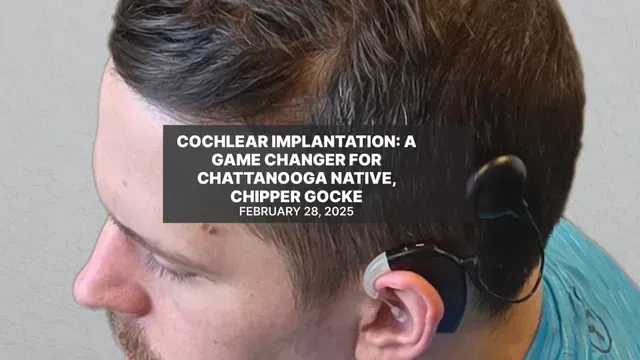
Cochlear implantation: A game changer for Chattanooga native, Chipper Gocke

March 6, 2025

Life-Changing Hearing Breakthrough for Chattanooga’s Chipper Gocke

A man with a cochlear implant in his ear.

Chipper Gocke, 28, has had many poignant moments in the last six weeks since his cochlear implant surgery. “A workmate commented recently that my speaking voice is the appropriate volume now. Not being able to hear myself, I probably often talked too loud before. It seems like a small thing, but it is a way to be more normalized in my professional and other settings.”


His mother, Amy Gocke, also has noticed the changes. “Chipper has never called me on the phone before. With his profound lifelong hearing loss and even using powerful hearing aids, he simply couldn’t communicate by phone. Now I look forward to his calls every day after he gets off work.”


These daily experiences that people often take for granted—communicating with a workmate or calling a family member to say hello—are now possible for Chipper because of his cochlear implant.


Hearing loss has been a part of Chipper’s life since he was a small child. Chipper’s father, Ted Gocke, relates, “From the time he was 18 months old, Chipper had ear infections that had us in and out of the hospital. That led to tubes in his ears and the diagnosis that he had a significant hearing loss.”


As a youngster, Chipper received early intervention services before he even reached school age. He also got established with local audiologist, Darnell Scafe, and they reconnected recently when Chipper sought out Darnell for hearing health care services as an adult. Darnell, who joined the Johnson Audiology team in 2018, says, “I remember Chipper as a sweet little boy who didn’t let his hearing loss slow him down. It’s wonderful to get to know the fine, capable young man he has grown into.”


Last year, Darnell encouraged Chipper to consider a cochlear implant, and she referred him to Johnson Audiology’s Cochlear Implant Program Director, Dr. Hannah Dearth. Dr. Dearth then was able to complete cochlear implant candidacy testing.


In November of last year, Chipper’s surgery was performed at Murfreesboro Medical Clinic (MMC) in Middle Tennessee by an otolaryngologist (ENT). A native of Chattanooga, Chipper traveled for the initial surgery since there is not currently an ENT in Chattanooga who performs CI surgeries. However, Chipper then had his cochlear implant activated at Johnson Audiology (JA) by Dr. Dearth in early January. Also, there to celebrate activation day was Darnell. “It felt like a full circle moment when Dr. Dearth activated Chipper’s cochlear implant, and he began to have those first sound perceptions.”


Dr. Dearth explains, “People often wonder how a hearing aid and a cochlear implant are different. Cochlear implants are designed for patients whose hearing aids are no longer assisting them in understanding in both quiet and noisy environments. A hearing aid is designed to provide amplification for speech sounds that are unintelligible without said amplification. Cochlear implants are a surgical option for those who are no longer able to achieve meaningful understanding with a traditional hearing aid. Hearing aids rely on the ear’s natural pathway for hearing to accomplish this and so may not work well for someone with severe damage to the inner ear. A cochlear implant, on the other hand, bypasses the damaged parts of the ear by stimulating the auditory nerve directly with a mild electrical current that sends the sound signal to the brain.”


Chipper is committed to his own success with his cochlear implant and in addition to listening to the speech of those around him, he is also tuning in to podcasts and audiobooks that give him even more speech exposure. Dr. Dearth says that is a huge factor in any patient’s ability to thrive with the device. “The patients who are committed to the aural rehabilitation as prescribed experience faster progress and higher success rates long term.”


Chipper will continue regular follow-up appointments for the rest of his life to maintain successful progress with his CI. He gets emotional talking about the social isolation that can be a common side effect of profound hearing loss and, also, mentions the spatial awareness that better hearing offers. “Being able to pinpoint sound and localize stimuli from both sides of the head has positive effects for living a safe life,” Dr. Dearth says.


Dr. Megan Johnson, audiologist, founder, and owner of JA, says, “Johnson Audiology has provided support for cochlear implant patients since 2017 with care offered through the practice’s location on Lee Highway in the East Brainerd area. After implantation, every other part of a CI patient’s hearing journey can be accomplished at Johnson Audiology—from initial activation to routine mapping.”


Chipper and his parents encourage people to explore the possibility of cochlear implants since it can make such a difference in a person’s daily life and function. Johnson Audiology is accepting new patients who currently wear hearing aids but would like to pursue cochlear implant candidacy as well as those who already have a cochlear implant. Call Johnson Audiology at 423.556.7185 or visit www.johnsonaudiology.com/schedule for more information or to schedule an appointment.

A couple of children sitting next to each other and a couple of people standing next to each other.

Chipper as a youngster with his brother, and Chipper as an adult with his audiologists, Dr. Hannah Dearth and Darnell Scafe.

See More Posts

By Jan Hollingsworth April 28, 2026
Experience Widex Allure™ at Johnson Audiology When it comes to better hearing, technology should do more than amplify sound—it should fit seamlessly into your life. At Johnson Audiology, we’re proud to offer Widex Allure, along with a full ecosystem of accessories that elevate your hearing experience even further. A More Natural Hearing Experience Widex Allure is designed to deliver one of the most natural sound experiences available today. With advanced processing and features like PureSound™, it provides clear, distortion-free speech while maintaining the richness of everyday sound. For our patients, that often means less listening fatigue and a more comfortable, realistic hearing experience throughout the day. Hear Better in the Moments That Matter Whether you’re in a busy restaurant or enjoying a quiet conversation at home, Widex Allure adapts to your environment—helping speech stand out while keeping background noise balanced. At Johnson Audiology, we customize these settings to your lifestyle, so your hearing aids perform where you need them most. Take Your Hearing Further with Widex Accessories One of the biggest advantages of choosing Widex Allure is the range of optional accessories that can enhance your hearing in specific situations. These are especially helpful for patients who want even more clarity, convenience, or connectivity. Better Conversations in Noise A portable microphone that brings speech closer and clearer in noisy environments. This small but powerful accessory acts like a personal microphone. It can be placed on a table during group conversations or worn by a conversation partner—streaming their voice directly to your hearing aids. Benefit: Ideal for restaurants, meetings, and family gatherings where background noise can be challenging. Why We Recommend Widex Allure at Johnson Audiology At Johnson Audiology, we believe hearing care should be personalized—not one-size-fits-all. That’s why we offer technology from all major manufacturers and help you choose what works best for your hearing, lifestyle, and goals. Widex Allure stands out because it offers: Exceptionally natural sound quality Improved speech understanding in noise Less listening effort and fatigue A full range of accessories to enhance everyday life Modern connectivity and convenience The Bottom Line Widex Allure is more than a hearing aid—it’s part of a complete hearing ecosystem. With the right combination of devices and accessories, you can hear more clearly in more places, with less effort. If you’re curious whether Widex Allure—and its accessories—are right for you, schedule a consultation with Johnson Audiology. We’ll guide you through your options and help you build a hearing solution that truly fits your life.
Two people in a natural setting observe a blue bird through binoculars, with musical notes illustrating the bird's song.
By Jan Hollingsworth March 31, 2026
When Life Gets Quieter: The First Sounds Hearing Loss Takes High-frequency sounds play a powerful role in how we experience the world—yet they’re often the first to fade when hearing loss begins. These sounds include birdsong, children’s voices, and many women’s voices, all of which carry pitches that sit higher on the hearing spectrum. Because of this, even mild hearing loss can quietly chip away at some of life’s most meaningful and emotionally rich moments. For many people, the first sign of hearing loss isn’t silence—it’s subtle absence. The cheerful chirping of birds in the morning may seem less vibrant or disappear altogether. Conversations with children may start to sound muffled or unclear, especially when they speak quickly or softly. Women’s voices, which often rely more on higher frequencies, can become harder to distinguish, particularly in group settings or noisy environments. These changes can happen gradually, making them easy to overlook or dismiss as background noise or distraction. This type of hearing loss, often associated with aging or prolonged exposure to noise, affects the tiny hair cells in the inner ear that are responsible for detecting high-frequency sounds. Once these cells are damaged, they don’t regenerate—meaning those crisp, detailed sounds become increasingly difficult to hear without intervention. The impact goes beyond missing pleasant sounds; it can affect communication, relationships, and overall quality of life. Misunderstandings in conversation may become more frequent. Social situations can feel frustrating or isolating. And those small, joyful sensory experiences—like hearing a child laugh clearly or enjoying a quiet moment filled with birdsong—can slip away. The good news is that hearing technology today is more advanced than ever. Modern hearing aids are designed to specifically target and amplify high-frequency sounds, helping to restore clarity and bring those missing details back into everyday life. Early detection is key, which is why regular hearing evaluations are so important—especially if you’ve started to notice these subtle changes. Hearing loss doesn’t have to mean losing connection to the sounds that matter most. By recognizing the early signs and taking action, it’s possible to rediscover the richness of sound—including the simple, beautiful notes that make life feel full. Schedule Your Hearing Evaluation Today Don’t let hearing difficulties take life's most enriching sound from. you. A simple hearing test can provide valuable insight into your hearing health and help you get back some of the sounds you have been missing. Visit www.johnsonaudiology.com/schedule to make a hearing evaluation appointment and start hearing the birds again.
By Jan Hollingsworth March 12, 2026
Starkey Omega AI Is Now Available at Johnson Audiology  There's a kind of exhaustion that comes with straining to hear — following along, nodding, guessing — and feeling like you missed most of it anyway. Better hearing technology doesn't just help you hear more. It helps you stop working so hard to listen. Starkey's newest platform, Omega AI, was built with exactly that in mind. And we're proud to now offer it at Johnson Audiology. Smarter Sound, Right When You Need It At the heart of Omega AI is DNN 360, the world's first deep neural network–powered directionality system. In real-world terms, that means voices stand out more clearly in the places that have always been the hardest: noisy restaurants, busy family events, crowded spaces. Starkey reports up to 28% better speech intelligibility and an 8 dB signal-to-noise improvement — without any sacrifice to battery life, which runs up to 51 hours. The AI doesn't stop there. A feature called TeleHear AI listens to your sound concerns and makes an instant adjustment with 93% accuracy right from the My Starkey app. And the built-in Gen AI Smart Assistant lets you ask questions, change programs, and set reminders using your voice, the same way you'd interact with a smart assistant on your phone. For patients who want more control between appointments, it's a meaningful shift in how hearing care works day to day. Built to Keep Up with Your Day Omega AI is waterproof with a coating tested to last 10 times longer than previous generations, so daily life; rain, sweat, an active schedule, isn't something you need to work around. New LED indicator lights let you confirm power and Bluetooth connection immediately, and in an industry first, those same lights double as a find-my-hearing-aid tool through the My Starkey app. More Than Just Hearing Omega AI also brings two health-focused tools to the My Starkey app. Balance Builder offers guided at-home exercises to support stability, especially valuable for patients managing fall risk. And an automatic respiratory rate monitor quietly tracks breathing in the background throughout the day, helping patients and their care teams stay a step ahead. Omega AI also supports Auracast™ connectivity, which lets you tune in to broadcast audio in public spaces including airports, theaters, places of worship, etc. directly through your hearing aids with a simple tap. It's the kind of feature that quietly makes a big difference in the moments that matter most. It's a reflection of something we believe deeply at Johnson Audiology: hearing care is health care. Let's Find the Right Fit for You If you're wondering whether Omega AI could be right for your hearing and your lifestyle, we'd love to help. Schedule a comprehensive hearing evaluation at any of our locations across Tennessee and North Georgia, and let our team guide you from there. Because better hearing isn't just about sound, it's about everything sound connects you to.